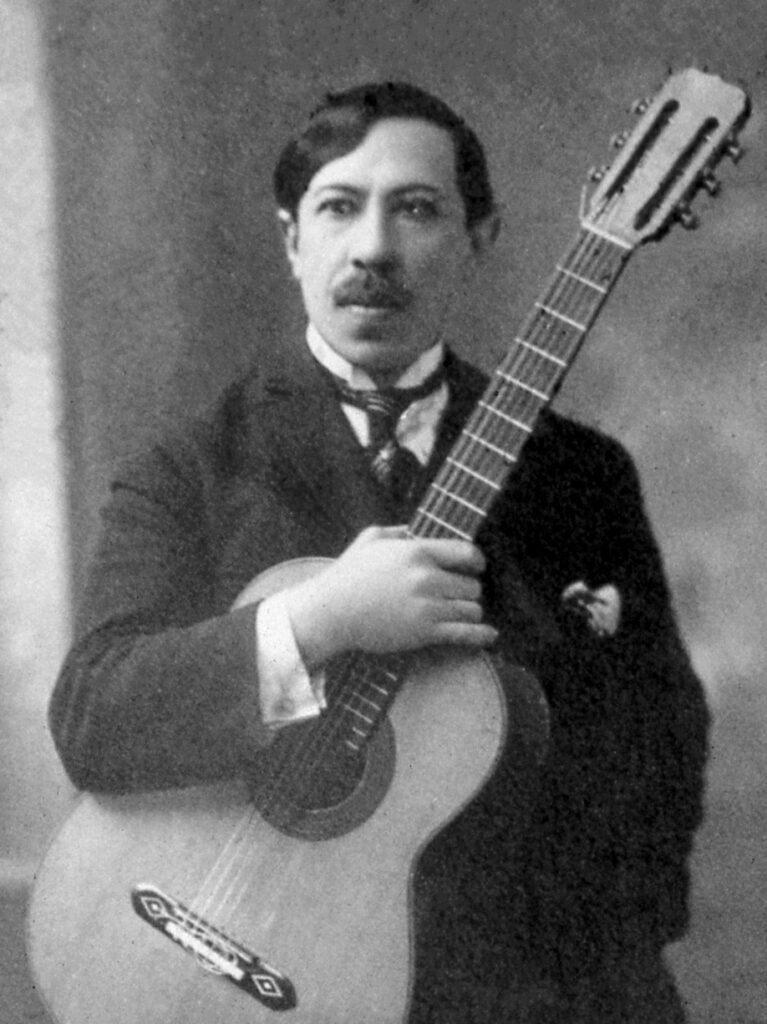
Biography
Agustín Barrios Mangoré: Poet of the Guitar
Agustín Pío Barrios Mangoré (5 May 1885 – 7 August 1944) was a Paraguayan classical guitarist and composer whose music joined Romantic virtuosity, European classical traditions and the musical character of Latin America. A celebrated performer as well as a prolific composer, he left a body of solo-guitar music that remains central to the modern classical-guitar repertoire.
Born in San Juan Bautista de las Misiones, Paraguay, Barrios showed musical ability from childhood. He played in his family’s musical ensemble and studied classical guitar with Gustavo Sosa Escalada, who introduced him to the repertoire of composers including Fernando Sor and Francisco Tárrega. He later continued his musical and academic education in Asunción.
Concert Life Across Latin America
Barrios began building his career as a concert guitarist in Paraguay before leaving the country in 1910. What began as a short trip developed into years of travel and performance across South America, including Argentina, Uruguay, Brazil and Chile. His career later took him through Central America, Mexico and Europe.
Barrios was also an important figure in the early history of recorded classical guitar. His surviving recordings preserve not only his compositions but also evidence of his remarkable technique, phrasing and expressive approach to the instrument.
Nitsuga Mangoré
During part of his career Barrios adopted the artistic persona Nitsuga Mangoré. “Nitsuga” reverses the letters of Agustín, while “Mangoré” referred to a legendary Guaraní figure. The name became closely associated with Barrios and today forms part of the identity under which his music is known around the world.
Composer and Musical Language
Barrios wrote extensively for solo guitar. His music draws on several worlds at once: the techniques and forms of the European classical and Romantic traditions, the influence of composers he admired, and rhythms and melodic elements associated with Latin American music. This combination gave his guitar writing a distinctive voice—virtuosic, lyrical and deeply idiomatic to the instrument.
Among his widely performed works are Julia Florida, Las Abejas, Danza Paraguaya, Un Sueño en la Floresta, Una Limosna por el Amor de Dios and La Catedral.
La Catedral
La Catedral is one of Barrios’s best-known compositions and one of the major works of the classical-guitar repertoire. Its three movements—Preludio Saudade, Andante Religioso and Allegro Solemne—move from introspection and spiritual stillness to brilliant, flowing virtuosity. Barrios began the work in the early 1920s and later added the prelude.
The work is also part of Paco Hallak’s album Feelings of Fantasies, where all three movements appear in the program.
Final Years and Teaching
After decades of performing and travelling, Barrios settled in El Salvador, where he taught guitar at the national conservatory. He continued composing and teaching until his death in San Salvador on 7 August 1944. His students and later generations of guitarists helped carry his music forward.
Legacy and Influence
Barrios’s reputation has continued to grow long after his death. His works unite demanding guitar technique with melody, colour and a strong sense of musical narrative, and they are now performed by classical guitarists throughout the world.
For guitarists, his legacy is especially significant because he was simultaneously composer, virtuoso performer and recording artist. His music expanded the expressive and technical possibilities of the instrument while preserving a distinctly Latin American voice within the international classical-guitar tradition.