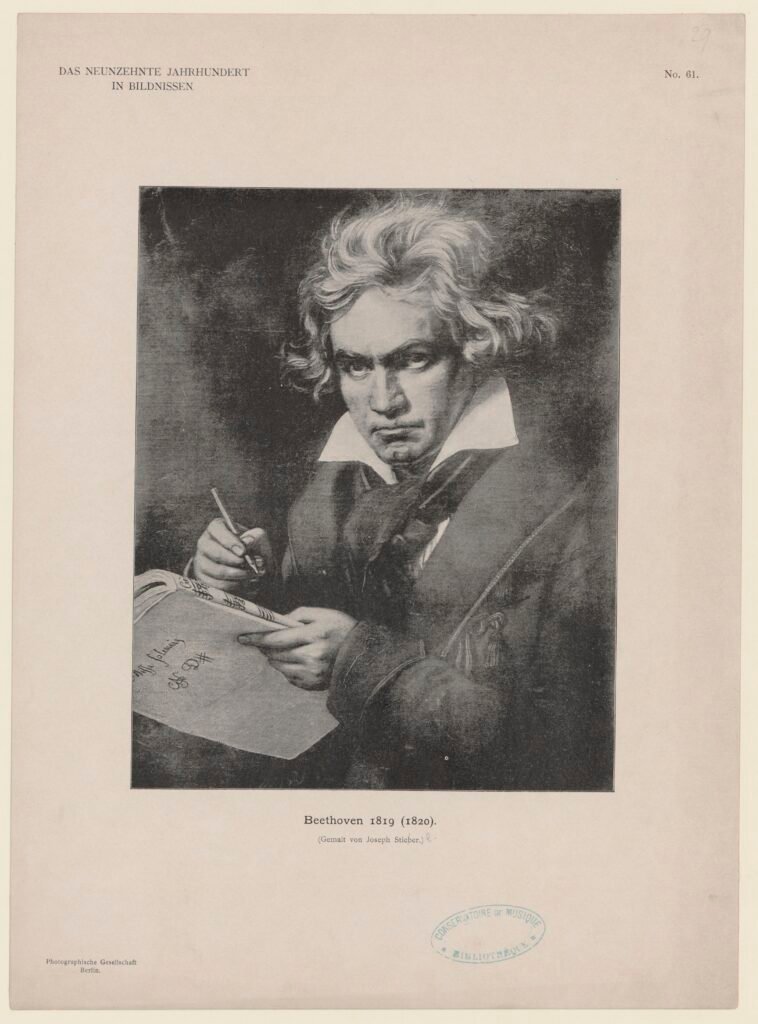
Biography
Ludwig van Beethoven: Drama and Architecture on the Guitar
Ludwig van Beethoven (1770–1827) transformed the language of the Classical era and opened new expressive possibilities that shaped nineteenth-century music. He did not establish a body of original music for guitar, but his strong motifs, dramatic contrasts and harmonic direction have long attracted guitarists and arrangers.
Beethoven and Plucked Strings
Although Beethoven is not known to have written original works for guitar, he did compose several surviving pieces for mandolin and piano in Prague in 1796, including works catalogued as WoO 43 and WoO 44. This gives us a genuine, if limited, connection between Beethoven and fretted plucked strings. It would be misleading to turn that into a claim that Beethoven was a guitarist.
Für Elise
Für Elise, WoO 59, is one of Beethoven’s most recognizable piano pieces. On solo guitar, its layers must be redistributed across the strings so the melody remains independent while the accompaniment retains its pulse and harmonic shape.
Why Beethoven Works in Transcription
Beethoven often builds large musical arguments from compact motifs. That strength of design can survive a change of instrumentation. The arranger’s task is to preserve dramatic direction even when the enormous dynamic and registral resources of piano or orchestra are reduced to one guitar.
Why Play Beethoven on Classical Guitar?
Beethoven asks the guitarist to think beyond the instrument: in long phrases, sudden contrasts, structural tension and release. Colour and articulation become tools for reproducing dramatic function rather than decoration.
Reduction Without Losing the Drama
An arrangement identifies the musical essentials—melody, bass, harmony, rhythm and crucial inner voices—and rebuilds them within the guitar’s range. The result can make familiar music feel unusually close and personal.
Legacy and Influence
Playing Beethoven on guitar is not an attempt to make the guitar sound like a piano. It is an interpretation: preserving Beethoven’s musical argument while allowing the resonance, attack and intimacy of the guitar to reveal another side of the work.